
Floral Wall Art, Reimagined: How LifelikeBloom Turns Open Frames into Living Compositions
Wall art usually asks you to choose between a picture and a plant. LifelikeBloom’s floral wall frames refuse that choice. Each piece starts as a simple open frame — no glass, no canvas — and becomes a three-dimensional botanical composition, with faux flowers and foliage spilling across the corners the way a climbing vine might grow across an actual window frame. The wall behind it isn’t hidden; it becomes part of the artwork, giving every arrangement negative space to breathe.
This piece walks through the range of ways we build these frames, using five real styling shots from our studio to show how the same idea shifts across color palettes and room settings.
The Concept: A Frame That Doesn’t Need Anything Inside It
Traditional floral wreaths and swags are built to be looked at as a whole. Our wall frames work differently — the eye moves along the wood, pauses where the blooms cluster at a corner or edge, then travels back out into open wall. It’s a format borrowed more from framed botanical illustration and modern gallery walls than from classic floral wreaths, which is why it reads as “art” first and “flowers” second.
Built Frame by Frame
Every base frame is slim hardwood, finished in a warm walnut or espresso tone so it reads as furniture-grade, not craft-store. Florals and stems are wired directly onto the frame in an asymmetric cluster, almost always concentrated in one or two corners, leaving the rest of the rectangle open. That asymmetry is deliberate: a fully-wrapped frame looks like a wreath pretending to be square; a frame with intentional empty space looks composed.
Autumn Palette: Rust, Mustard, and Ranunculus
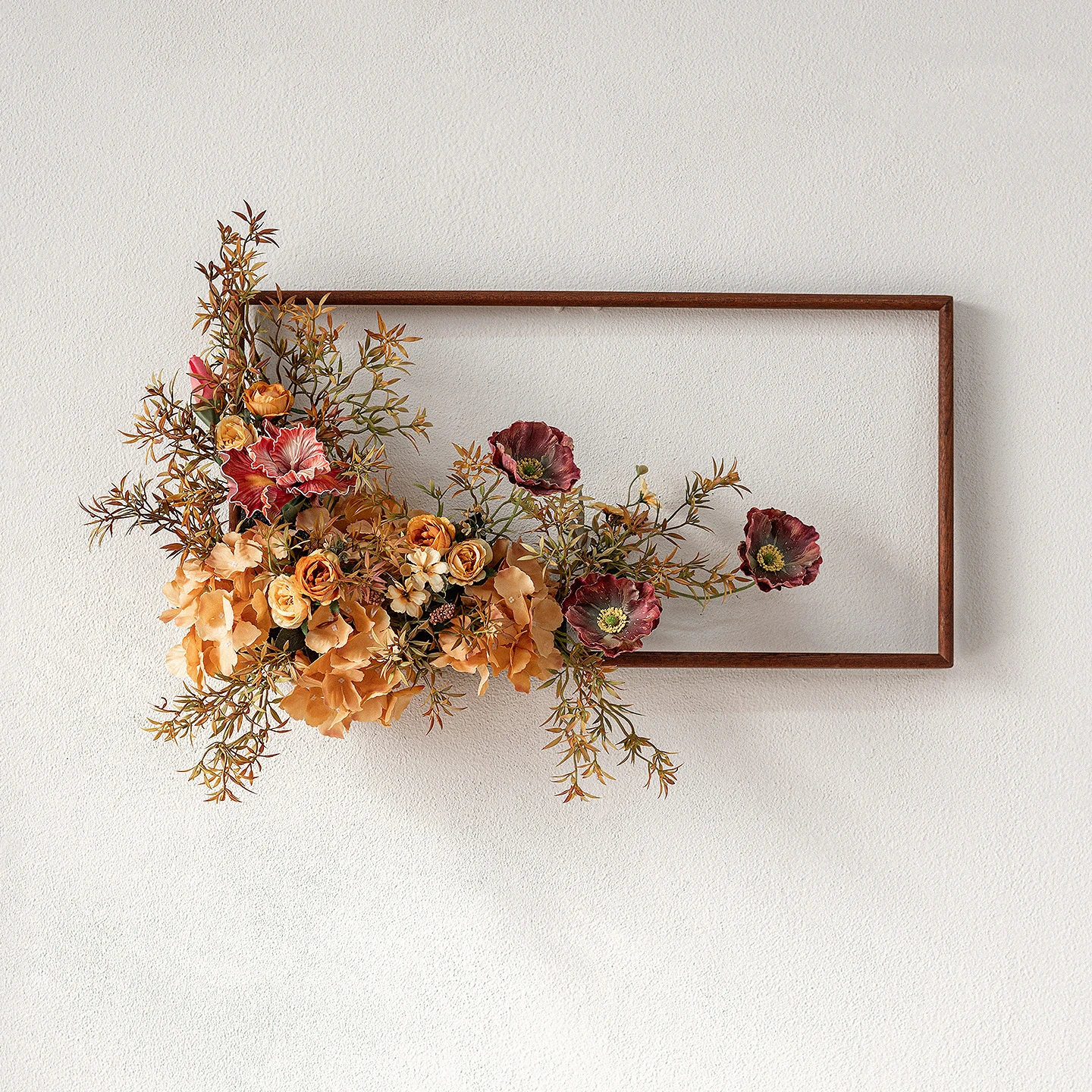
Our autumn-toned frame leans into deep burgundy poppies, warm mustard hydrangea, and clustered amber roses, anchored by feathery seeded foliage that drapes down and out of the frame’s lower edge. It’s designed to read as “harvest” without tipping into literal pumpkins-and-leaves territory — the color story does the seasonal work on its own.
Styling Tip: Let It Anchor a Reading Chair or Console
Because the composition is bottom-heavy and horizontal, this frame works best hung slightly lower than eye level, above a console table or reading chair, where the cascading foliage appears to spill toward the surface below it.
White & Orange Palette: Calla Lily, Orchid, and Dahlia
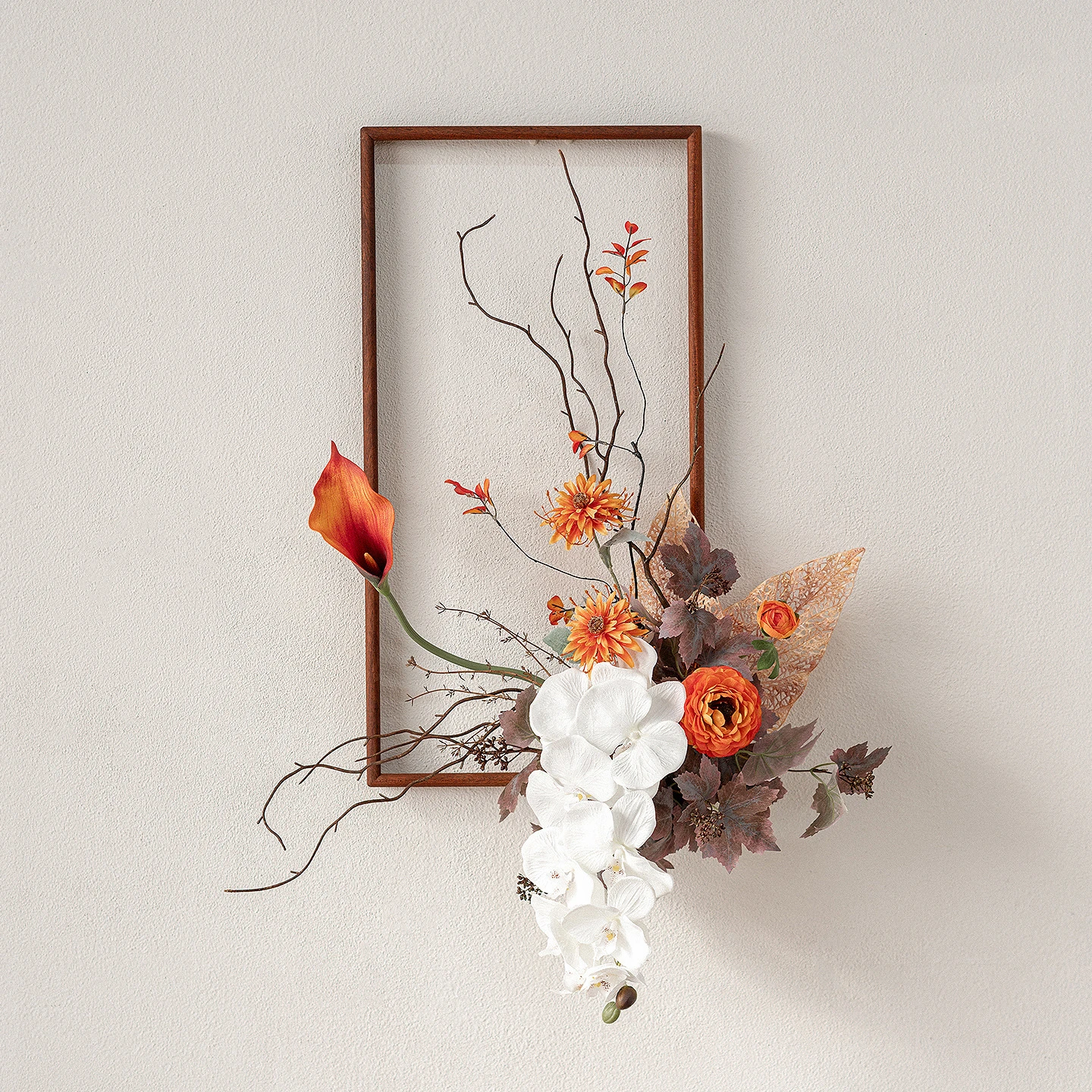
A narrower, more vertical frame carries a different mood entirely — a single orange calla lily reaching up one side, paired with cascading white phalaenopsis orchid blooms, orange dahlias, and a ranunculus tucked against dark, textured autumn-leaf accents. The bare branch-like stems that cross the open center of the frame add a linear, almost ink-drawing quality that keeps the piece from feeling too full.
Detail Worth a Closer Look
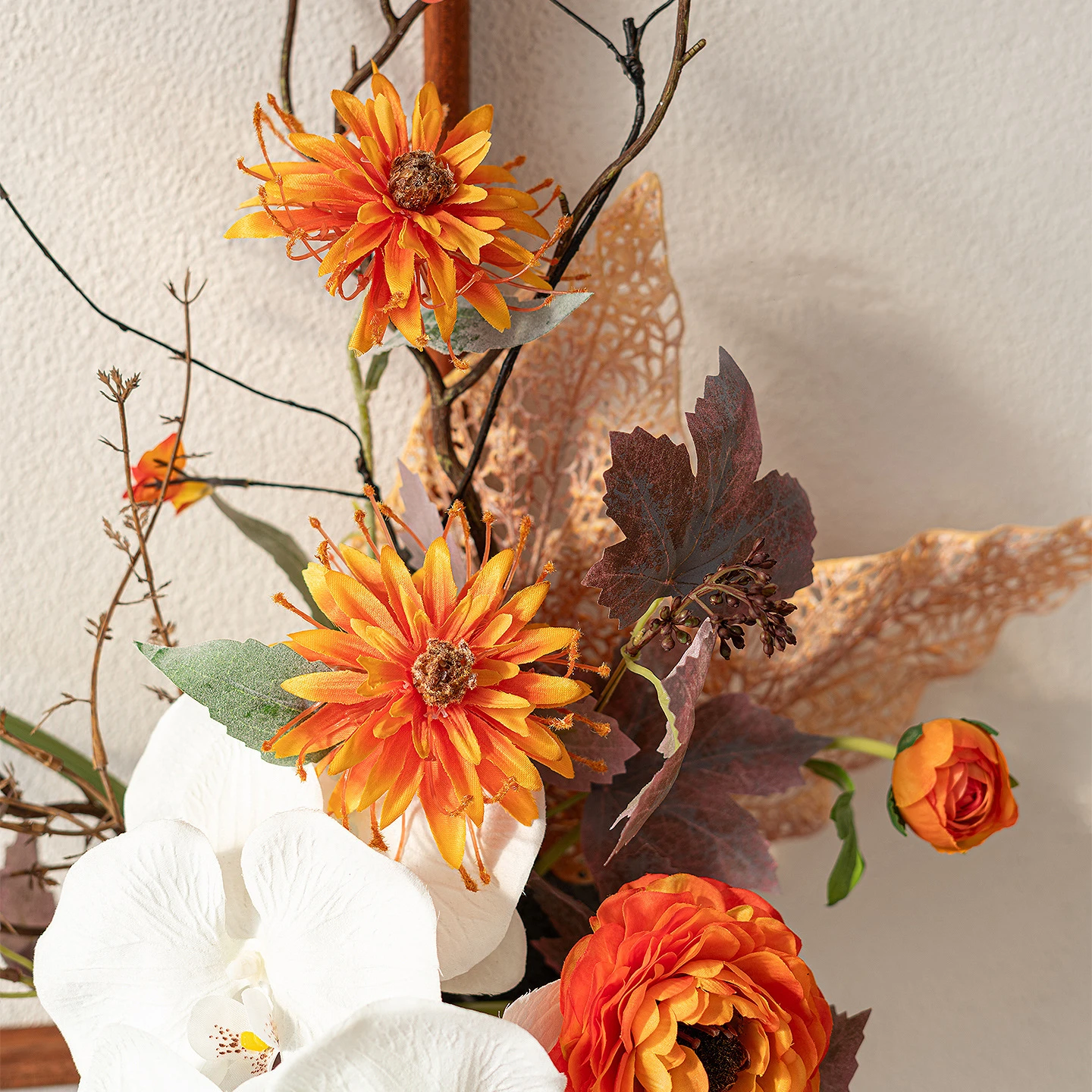
The dahlia and ranunculus blooms in this piece use a matte, slightly frayed petal edge rather than a glossy finish, which is what keeps the orange tones looking like flowers rather than plastic. A close-up shot of this same corner shows the layering clearly: dahlia, orchid, ranunculus, and a papery bronze leaf all overlapping at slightly different depths.
Lilac Palette: A Frame Fully Claimed by Blooms
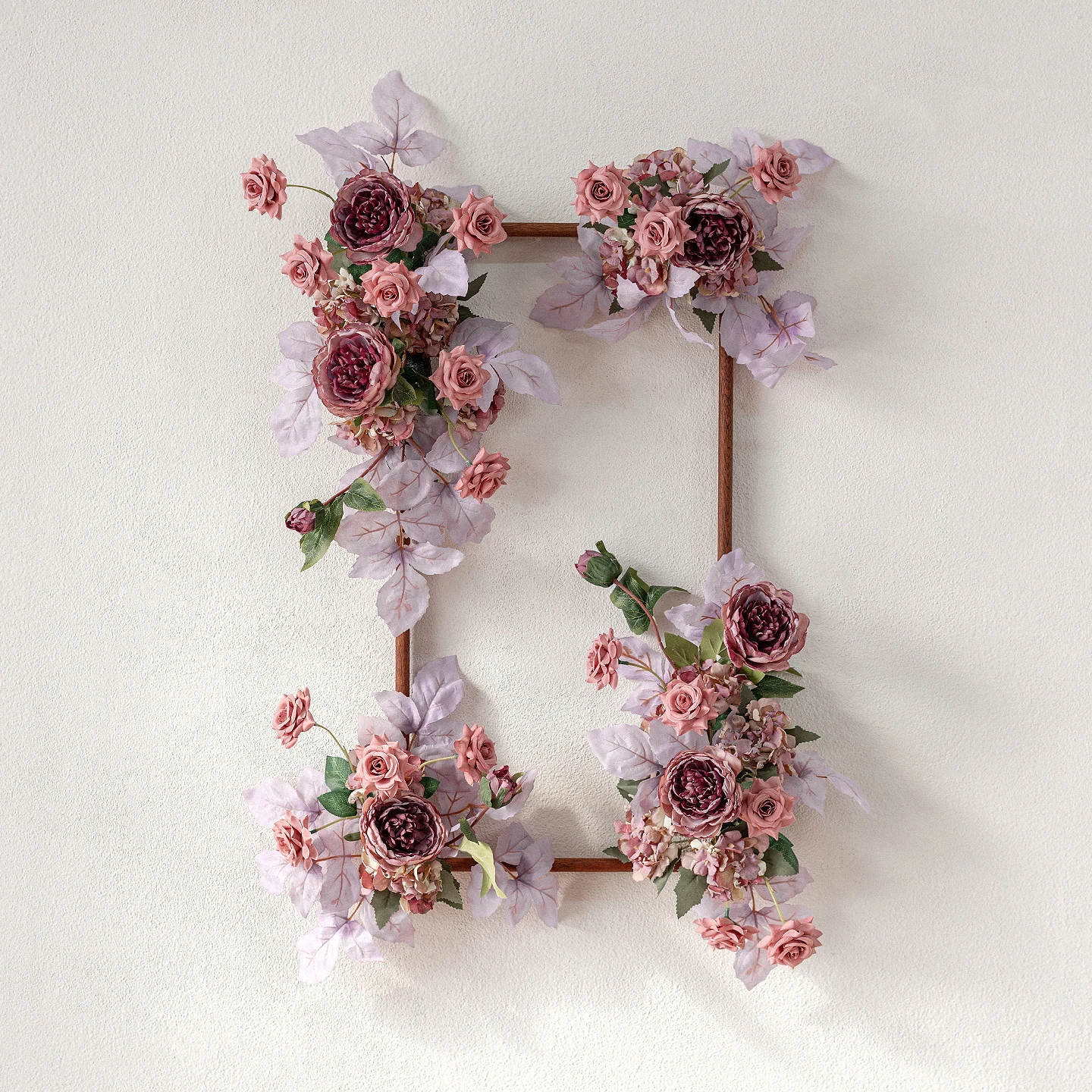
Where the autumn and citrus frames leave most of the rectangle open, our lilac-toned piece takes the opposite approach — dusty mauve roses, deep plum peonies, and pale lilac-veined leaves cluster at all four corners of a rectangular frame, almost meeting in the middle. It’s the most romantic, maximalist option in the collection, closer to a floral monogram than a botanical sketch.
Styling Tip: Use It Where It Can Be the Only Statement
Because all four corners are filled, this frame doesn’t need supporting decor around it — it reads as complete on its own, which makes it a strong choice for a narrow hallway wall or above a bed where a single, self-contained piece works better than a gallery cluster.
Peach Corner Palette: Understated and Airy
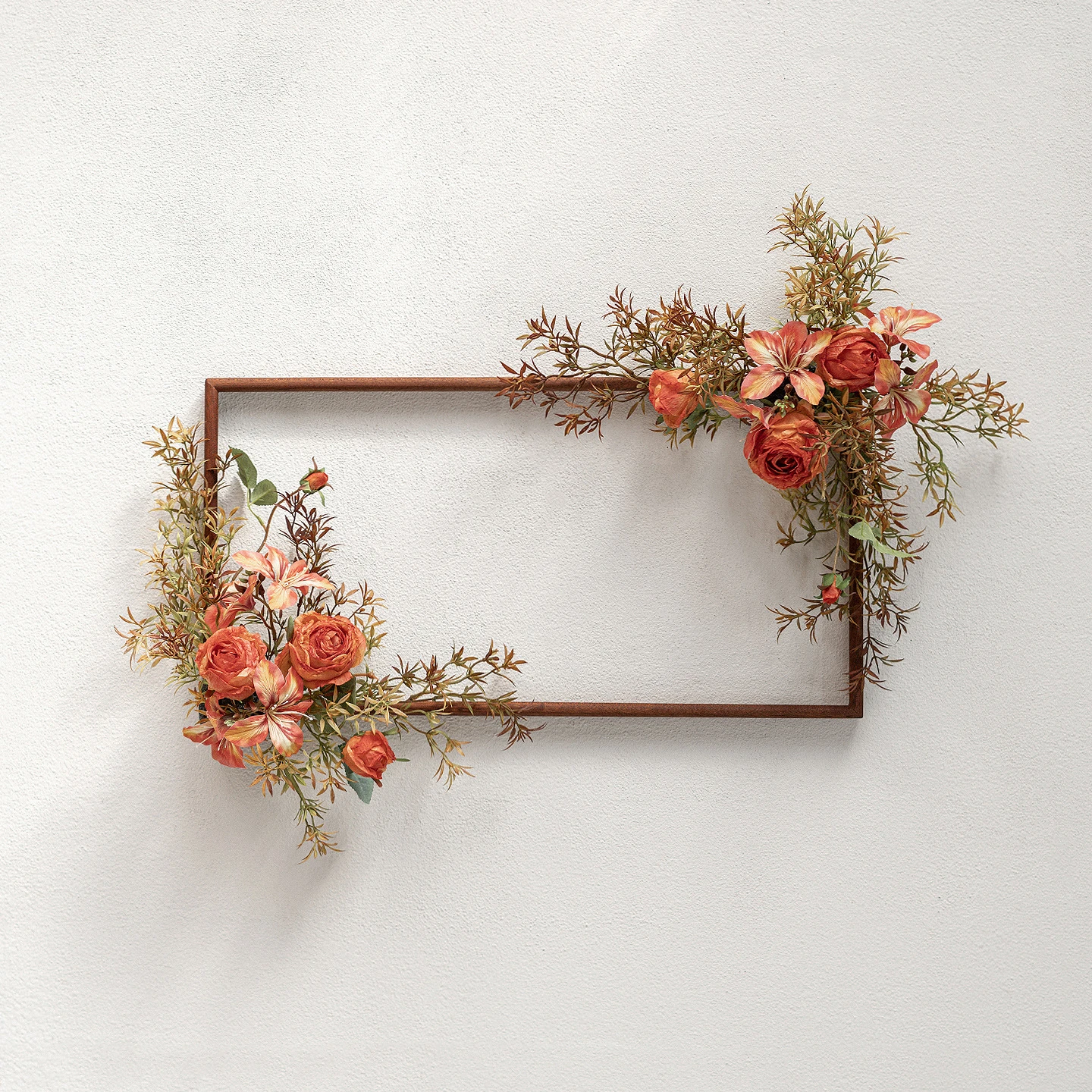
The most minimal frame in the lineup uses two diagonal corners — terracotta roses and coral alstroemeria at top right, echoed by a smaller cluster at bottom left, connected by wispy dried-look foliage that traces the frame’s inner edge. It’s the piece we recommend most often for smaller walls or tight corners, since roughly seventy percent of the frame stays open.
Choosing the Right Frame for Your Wall
- Small or narrow walls: the peach diagonal-corner frame, since most of the rectangle stays open.
- A single statement piece: the lilac all-corners frame, which needs no additional decor around it.
- Above furniture with visual weight below: the autumn frame, whose bottom-heavy cascade echoes a console or chair.
- A vertical gap, like beside a doorway: the white and orange frame, built on a tall, narrow silhouette.
Because none of these pieces use real florals, they hold their color and shape indefinitely — no fading from direct light exposure beyond normal fabric care, no seasonal replacement, and no water damage to the wall behind them.[Explore LifelikeBloom →] [Shop All →][Shop Dried Flowers & Wreaths →] [Shop Artificial Floral Wall Art Frame →]